
Audience Research Tool for Evidence-Led Prioritization
An audience research tool helps collect or analyze evidence about customer groups, needs, behavior, language, and channels. Klinko is built for the decision after discovery: comparing candidate audiences and choosing who to validate first.

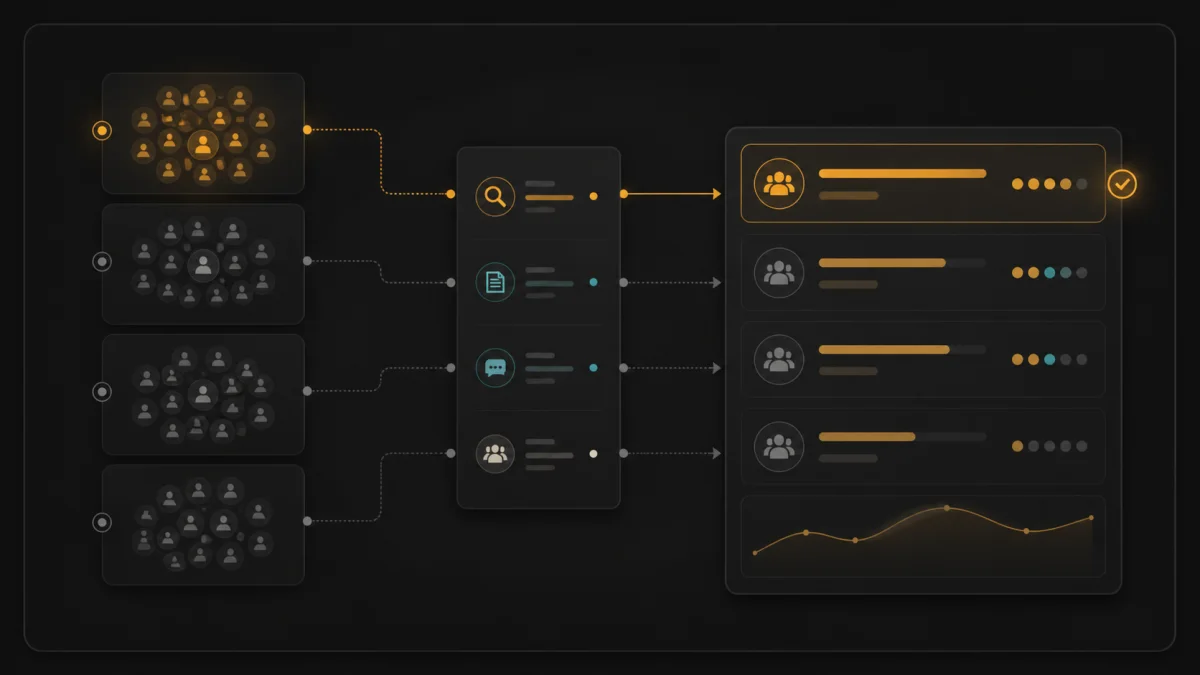
Who should you serve first, and what should you validate next?
Klinko does not treat audience research as a static persona exercise. It preserves sources and uncertainty, ranks alternatives with consistent criteria, and turns the leading hypothesis into a next test.
- Early-stage founders without a research team
- Product marketers testing a new audience
- Agencies preparing evidence-led client strategy
More information, but the decision stays unclear.
- More dashboards for the team to interpret
- Static profiles can hide changing context
- Research findings often stop before validation
Compare on consistent criteria and set a priority.
- Find candidate target audiences
- Separate recurring demand from isolated complaints
- Compare motivation and product fit
- Find audience language and channel evidence
A complete path from market question to next validation.
- 01
Question
Start with the audience decision the team must make.
- 02
Evidence
Collect several source types and retain opposing signals.
- 03
Segments
Form candidate groups around shared situations and needs.
- 04
Priority
Apply the same criteria across every candidate.
- 05
Test
Validate the highest-risk assumption behind the leader.
Not just a conclusion—a decision your team can inspect.
Decisions supported
- Find candidate target audiences
- Separate recurring demand from isolated complaints
- Compare motivation and product fit
- Find audience language and channel evidence
- Design a small validation test
Quality standard
- Material rationale for each recommendation
- Confidence and important limitations
- Counterevidence that could change the ranking
- A clear requirement for real-world validation
Final output
- Audience shortlist
- Segment comparison
- Language and need patterns
- Channel hypotheses
- Validation brief

Who is most likely to pay for an AI meeting assistant?
Research finding
Public evidence separates general remote workers from account teams whose missed follow-ups carry client and revenue consequences.
Current decision
Test agency account teams first rather than target all remote workers.
Insight is not certainty. Validation still matters.
- Public evidence may not represent the full customer population.
- Research output is not a forecast or guaranteed conversion result.
- Interviews and experiments remain necessary.
Questions about audience research tool
What should an audience research tool include?
Is audience research the same as market research?
How does Klinko avoid generic personas?
Can small teams use Klinko?
Connect the next market decision.
Start with one real market question.
Compare evidence, rank the opportunity, and choose the next validation.
Start Market Research →