
AI Market Research Tools: What to Evaluate Before You Choose
AI market research tools use machine learning or language models to collect, organize, analyze, or summarize market evidence. The useful distinction is whether a tool only generates text or supports a traceable decision.

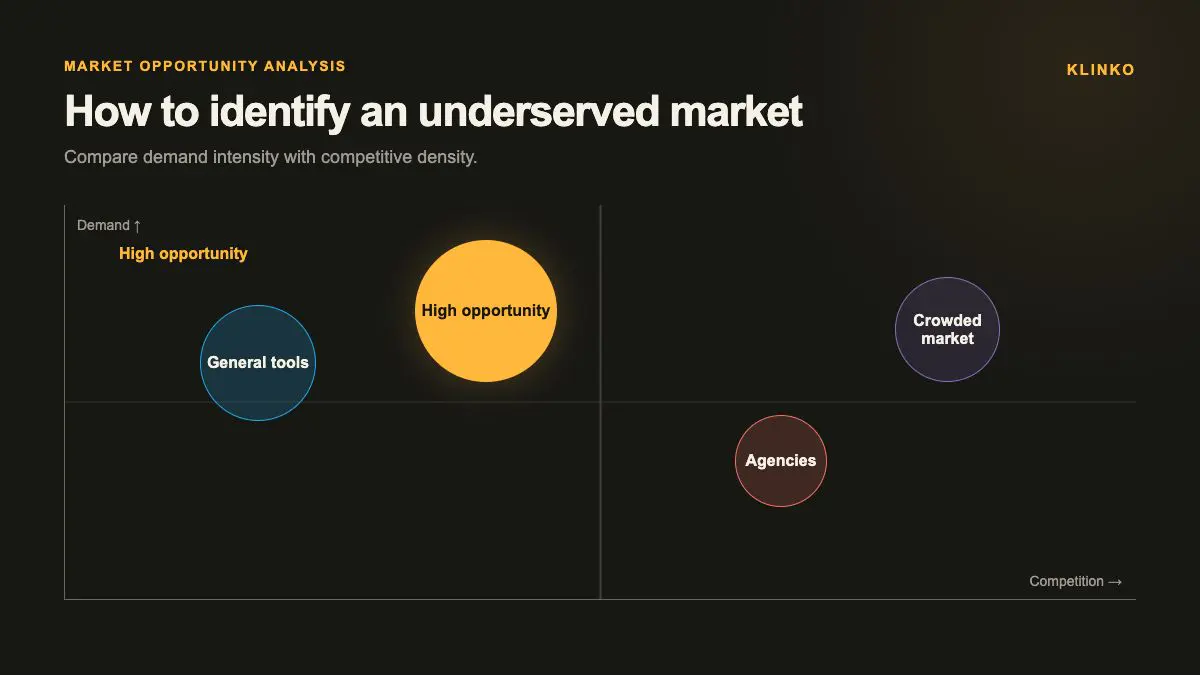
Who should you serve first, and what should you validate next?
Klinko is designed around evidence-led market questions. It shows decision criteria, preserves assumptions and counterevidence, ranks options, and recommends the next validation instead of presenting fluent output as proof.
- Founders comparing AI research products
- Small teams seeking faster market analysis
- Teams concerned about unsupported AI conclusions
More information, but the decision stays unclear.
- More dashboards for the team to interpret
- Static profiles can hide changing context
- Research findings often stop before validation
Compare on consistent criteria and set a priority.
- Frame a focused market question
- Evaluate current market evidence
- Compare audience or market candidates
- Preserve assumptions, counterevidence, and limitations
A complete path from market question to next validation.
- 01
Question
Ask what decision the research must change.
- 02
Evidence
Evaluate current evidence rather than relying on model memory.
- 03
Comparison
Apply consistent decision criteria across candidates.
- 04
Boundary
Separate evidence, inference, recommendation, and unknown.
- 05
Validation
Recommend the real-world evidence needed next.
Not just a conclusion—a decision your team can inspect.
Decisions supported
- Frame a focused market question
- Evaluate current market evidence
- Compare audience or market candidates
- Preserve assumptions, counterevidence, and limitations
- Produce an action-ready validation brief
Quality standard
- Material rationale for each recommendation
- Confidence and important limitations
- Counterevidence that could change the ranking
- A clear requirement for real-world validation
Final output
- Evidence summary
- Ranked candidates
- Decision rationale
- Unknowns and counterevidence
- Next validation plan

Can AI choose the best audience for a startup?
Research finding
AI can compare signal patterns, but the result is only useful when sources, criteria, uncertainty, and counterevidence remain visible.
Current decision
Use AI to narrow and rank the field, then confirm the leading assumption with customer and behavioral evidence.
Insight is not certainty. Validation still matters.
- AI output can be wrong or incomplete.
- Model fluency is not evidence quality.
- Sensitive, regulated, or consequential uses require additional review.
Questions about AI market research tools
What should I look for in AI market research tools?
Can ChatGPT do market research?
Does AI replace a market researcher?
How is Klinko different from a generic AI prompt?
Connect the next market decision.
Guides, comparisons, and next steps
Audience research tools guide→Market opportunity analysis guide→Klinko vs BuzzAbout→Klinko vs Delve AI→Review Klinko pricing→Start with one real market question.
Compare evidence, rank the opportunity, and choose the next validation.
Start Market Research →