
Product Validation Software for Testing the Riskiest Assumption
Product validation software helps teams test whether a problem, audience, solution, or buying assumption is credible before committing significant resources. Klinko identifies which assumption matters most and what evidence is still missing.

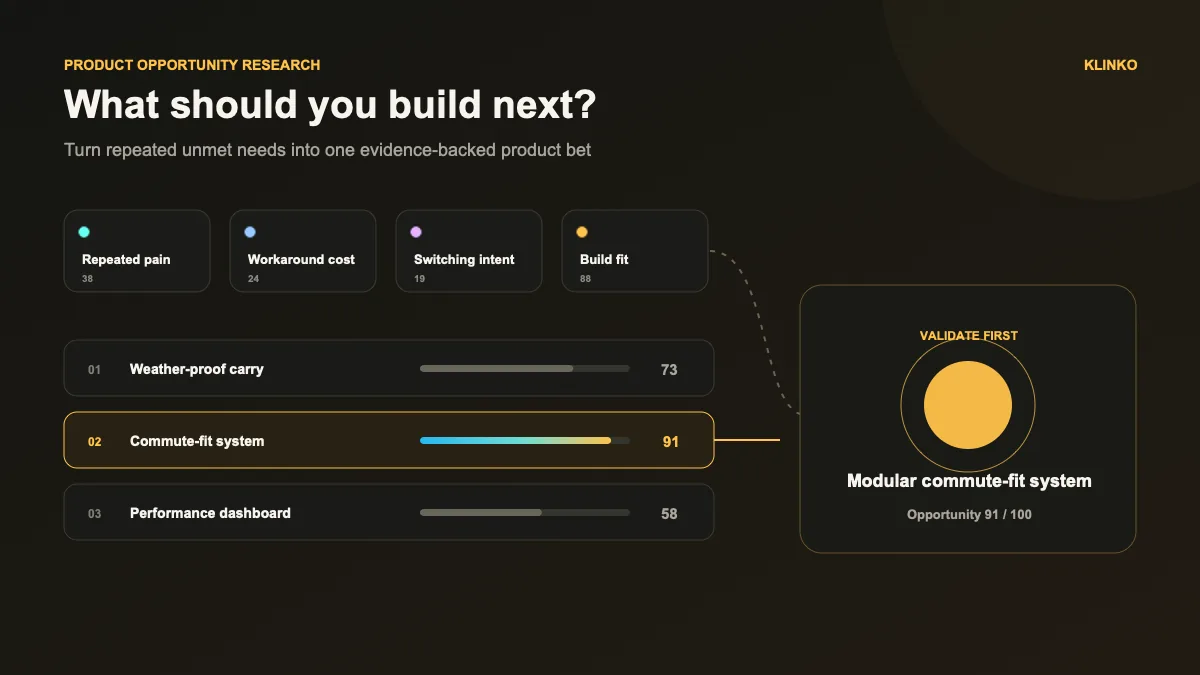
Who should you serve first, and what should you validate next?
Validation is not a single score that declares an idea good or bad. Klinko separates evidence from inference, finds the weakest consequential assumption, and recommends a test matched to that uncertainty.
- Founders testing an idea before building
- Product teams evaluating a feature or pivot
- Studios comparing several concepts
More information, but the decision stays unclear.
- More dashboards for the team to interpret
- Static profiles can hide changing context
- Research findings often stop before validation
Compare on consistent criteria and set a priority.
- Identify the riskiest assumption
- Check whether the problem recurs
- Compare current alternatives and switching friction
- Evaluate audience and product fit
A complete path from market question to next validation.
- 01
Map
List audience, problem, solution, access, and buying assumptions.
- 02
Evidence
Attach supporting and opposing signals to each assumption.
- 03
Risk
Prioritize assumptions by uncertainty and consequence.
- 04
Test
Select the smallest credible experiment for the top risk.
- 05
Update
Change the decision when new behavioral evidence arrives.
Not just a conclusion—a decision your team can inspect.
Decisions supported
- Identify the riskiest assumption
- Check whether the problem recurs
- Compare current alternatives and switching friction
- Evaluate audience and product fit
- Choose an interview, message, prototype, or paid-intent test
Quality standard
- Material rationale for each recommendation
- Confidence and important limitations
- Counterevidence that could change the ranking
- A clear requirement for real-world validation
Final output
- Assumption map
- Evidence gaps
- Risk priority
- Validation test brief
- Decision update criteria

Will remote teams pay for another meeting assistant?
Research finding
Summary demand is common, but stronger economic consequences appear around client commitments and follow-up ownership.
Current decision
Do not validate “better summaries.” Test whether agency teams pay to prevent missed client commitments.
Insight is not certainty. Validation still matters.
- Public interest is not proof of paid demand.
- A validation score cannot guarantee product-market fit.
- The quality of the result depends on testing real behavior.
Questions about product validation software
What is product validation?
When should a startup validate an idea?
Which validation method is best?
Can Klinko tell me whether to build?
Connect the next market decision.
Guides, comparisons, and next steps
Audience research tools guide→Market opportunity analysis guide→Klinko vs BuzzAbout→Klinko vs Delve AI→Review Klinko pricing→Start with one real market question.
Compare evidence, rank the opportunity, and choose the next validation.
Start Market Research →